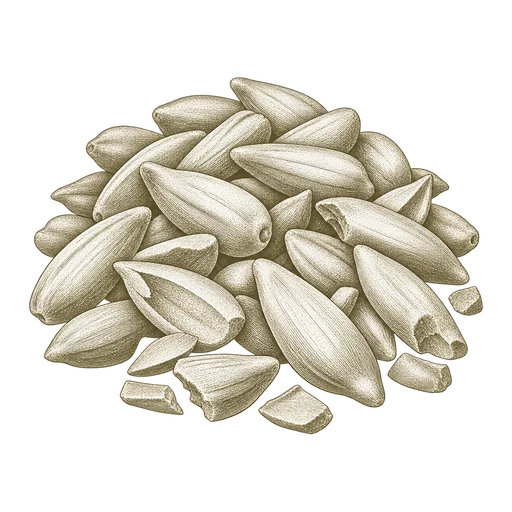
Why “medium” needs a measurable definition
“Medium” is a descriptive grade, not a universal particle-size standard. One seller’s medium sunflower chips may not match another’s because the term alone does not identify the sieve openings used, the share of product expected in that size band, or how much material outside it is acceptable. A name on a quote or product sheet is not enough to compare offers reliably.
For a useful specification, describe the size distribution rather than relying on a single label. Identify the sieve or sieves that define the target fraction, state whether the chips should pass through or remain on each sieve, and set tolerances for each fraction. These details tell both parties what “medium” means and provide a basis for evaluating the offered product and its lot analysis.
Use sieve openings, pass-through and retention
A sieve specification refers to openings that separate particles by size. Material that passes through an opening is distinguished from material retained on it. For example, a buyer can define a target band using an upper and lower sieve boundary, then specify the desired proportions passing or retained at those boundaries. The exact sieve openings and tolerances should come from the buyer’s process or product requirements; there is no single set of values established by the word “medium.”
Write the direction of separation explicitly. “Retained on” and “passes through” describe opposite outcomes, and an unclear phrase can lead to different interpretations. If several sieves are used, name the opening for each and state the fraction expected between them. Also define how results are reported, so the specification and lot analysis can be compared on the same basis.
Make fines and out-of-grade material visible
A target size band does not describe the entire lot. Smaller fragments and dust-like fines can collect below the selected sieve, while larger pieces may remain above the target range. Both affect the distribution that reaches a mixer, feeder or packaging line. A specification should therefore address the amount of material below the lower boundary and above the upper boundary, not just the desired fraction.
Fines matter when a process depends on consistent particle size or when smaller material separates during conveying and handling. Larger pieces can create a different issue if equipment or a finished blend is designed for a narrower grade. Specify these fractions separately where they matter, and avoid treating a target band as proof that the rest of the lot is controlled.
Define kernel identity and supporting quality fields
Size alone does not establish what the chips are made from. State the required identity clearly, such as sunflower kernel pieces, and address whether visible hull or other foreign material is acceptable for the intended use. A supplier’s product description and lot analysis should use the same identity terms; otherwise, a matching sieve distribution may still describe a different material than the buyer expects.
Other quality fields can support the size definition without being confused with it. Depending on use, buyers may assess foreign material, color or appearance, odor, moisture, and relevant food- or feed-quality measures. These are not substitute particle-size criteria. List only fields that matter to the intended application, specify the reporting basis where needed, and compare results against the buyer’s own acceptance requirements rather than assuming universal limits.
Turn the grade into a comparable purchase specification
A practical specification brings the elements together: product identity; sieve openings and pass-through or retention direction; tolerances for the target fraction; limits or reporting for fines and oversized material; and any additional quality fields required for the use. Ask for the offered grade definition and current lot analysis, then check that the sieve method and terms in the analysis match the purchase specification. A report that says only “medium” cannot demonstrate whether the particle distribution meets a separately defined requirement.
Before comparing wholesale offers, share the intended application and the particle-size boundaries that matter to your equipment or blend. Clarify any remaining terms with the broker so the quoted grade, analysis and order description refer to the same product. For sourcing, visit the [Medium Sunflower Chips page](/ingredients/medium-chips) and provide the sieve definition you need.
BEFORE YOU REQUESTYour sourcing checklist.
- Name the product identity required, including whether the order calls for sunflower kernel pieces and what hull or foreign material criteria apply.
- List the sieve openings that define the target grade and state whether each fraction should pass through or be retained.
- Set tolerances for the target fraction and define how fines and material above the target range are reported or controlled.
- Request the offered grade definition and current lot analysis, checking that their sieve terms and reporting basis match your specification.
- Share quantity and unit, destination, timing, packaging or receiving method, and any application-specific quality fields needed for a useful quote.
Common questions.
Is there a standard sieve size for medium sunflower chips?+
No universal sieve size follows from the word “medium.” Define the grade with named sieve openings, clear pass-through or retention directions, and tolerances for the fractions that matter.
Why specify fines separately from the target chip size?+
A target size band does not define the amount of smaller material below it. Reporting fines separately makes the full size distribution more transparent and helps buyers assess whether it suits their process.
What should I compare between a sunflower chips grade and its lot analysis?+
Compare product identity, sieve openings, pass-through or retention terms, fraction tolerances, and the reporting basis. Also review any separate quality fields required for the intended use.