Kernel pieces without whole seed shells
The hulled, broken form distinguishes these chips from whole sunflower seed. This physical difference is relevant when designing bird-feed products or matching ingredients to feeder and blending equipment.
Ingredient intelligence · quote-ready sourcing
Also searched as Sunflower coarse chips, Coarse sunflower kernel chips, Sunflower hearts coarse chips
Coarse sunflower chips are broken, hulled sunflower kernels used most clearly in wild-bird feed. Compare the seller’s particle-size definition, fines and hull limits, kernel condition and intended-use grade when planning a bulk order.
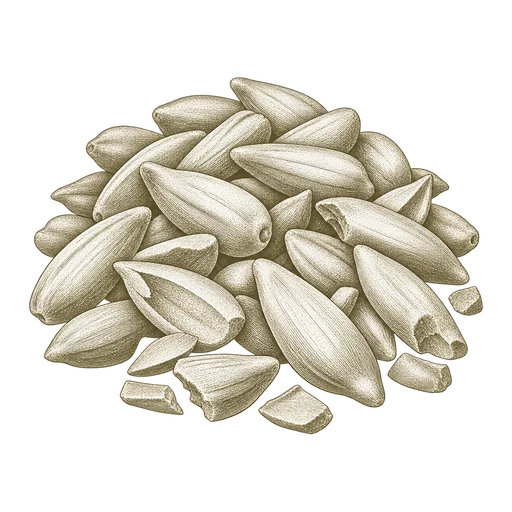
Coarse sunflower chips are broken pieces of hulled sunflower kernels, also known as sunflower meats or hearts. Unlike sunflower meal, they are not the ground residue left after oil extraction.
The coarse grade is a particle-size distinction, but the name does not establish a universal screen range. A seller’s size distribution, fines and hull-remnant limits describe the offered material more usefully than the grade name alone.
The hulled, broken form distinguishes these chips from whole sunflower seed. This physical difference is relevant when designing bird-feed products or matching ingredients to feeder and blending equipment.
Coarse and fine chips can behave differently in feeding and mixing systems. Screen distribution and fines content make the size grade measurable and help buyers assess whether it fits their process.
Moisture, residual hulls, kernel condition and relevant testing describe characteristics that the name “coarse chips” does not cover. These details help distinguish physical grade from quality and intended-use requirements.
| Characteristic | Why it matters |
|---|---|
| Particle-size distribution | Defines what coarse means for the offer and how much material falls into other size bands. |
| Fines and hull remnants | Describes the amount of small material and residual shell in the kernel pieces. |
| Moisture and kernel condition | Relevant to product condition, storage management and acceptance criteria. |
| Intended-use grade | Identifies whether the product is offered for bird feed or another specified use; suitability should not be inferred. |
| Required testing and analysis | Names the measurements, test methods and acceptance limits relevant to the buyer’s program. |
The reviewed numerical limits belong to a specific supplier specification and are not universal coarse-chip standards. Set contract values against the offered product and stated measurement basis.
Wild-bird feed is the best-supported use for coarse hulled sunflower chips. Broken kernels provide kernel pieces without whole seed shells, making the physical form relevant to feeder design and to products intended for birds. A specification labeled for bird feed does not, by itself, establish suitability for every bird species or every feed formulation.
Sunflower meats also appear in broader bird, pet and animal-food ingredient markets, but the intended grade and applicable ingredient requirements still matter. Do not infer human-food suitability from the sunflower identity: a product specification may explicitly restrict a particular lot to feed use. For any other end use, establish the product’s identity and intended-use documentation before purchase.
Sunflower kernels contain oil, so storage history and protection from moisture are relevant to quality. Keep the receiving plan focused on a dry, protected storage area and on handling practices that limit moisture exposure and contamination. Do not assume a shelf life or storage limit from the coarse-chip name; use the offered product’s guidance and condition.
Before arranging delivery, match the requested packaging and shipment arrangement to the facility’s unloading equipment and storage capacity. The order should distinguish the required particle-size grade from packaging and receiving needs, so that product quality and delivery planning are addressed together.
A useful request identifies the botanical material as hulled sunflower kernels, the required coarse-size definition, quantity and unit, destination, timing, and packaging or receiving method. Include the intended use and any limits for particle distribution, fines, hull remnants, moisture or kernel condition.
Ask for the current specification and lot analysis, including the measurement basis and test methods for criteria that matter to your program. If microbial or mycotoxin testing is required, name the tests and acceptance limits. Human-food or animal-food suitability should be supported by documentation for the specific offered product, not assumed from a related sunflower ingredient.
Coarsely broken, hulled kernels are used in wild-bird feed. The kernel-piece form differs from whole seed, but the product grade should still match the intended feeder or finished-feed requirements.
Manufacturers can evaluate coarse chips as a sunflower kernel ingredient in feed blends. Particle-size distribution, fines and hull remnants help determine whether a particular lot matches the blend and handling process.
Sunflower meats are used in broader animal-food ingredient markets, but a market use does not establish that every coarse-chip lot is suitable for every species or formulation. Confirm the offered grade and applicable use requirements.
State that the requirement is for hulled sunflower kernel chips and specify the seller’s coarse-size definition, quantity and unit, destination, and requested timing. Include the intended use because a bird-feed grade does not establish suitability for other markets.
Specify the packaging or receiving method your facility can handle and describe unloading equipment and storage capacity. These details matter for matching the shipment arrangement to the site; packaging and freight terms depend on the specific offer.
Plan for dry, protected storage and handling that limits moisture exposure and contamination. Ask for the offered lot’s handling guidance and storage history where relevant; do not assume a shelf life or storage limit from the product name.
Bakery kernels is a broad label for kernels, seeds or blends used in baked goods—not one standardized ingredient. Specify the species, form and quality needs, since whole, chopped, roasted, ground and blended products differ in recipe role and handling.
Explore ingredientBlack-oil sunflower seed is a black-hulled oilseed used in bird feeding, oil processing and animal-feed formulations. Specify whole seed or a processed form, then compare lot quality and storage requirements against the intended use.
Explore ingredientFine Chips are broken or size-reduced sunflower kernels used in wild-bird feed products. Compare the seller’s chip-size definition, hull content and lot analysis, then match packaging and receiving details to your facility.
Explore ingredientMedium Chips commonly refers to broken, peeled sunflower kernels used in bird-feed and related ingredient markets. Because “medium” has no universal size definition, compare the sieve cut, intended grade and lot quality before arranging a bulk order.
Explore ingredientThey are coarsely broken, hulled sunflower kernels, also described as sunflower meats or hearts. The word “coarse” does not set a universal size limit, so compare the seller’s screen definition or particle-size distribution.
No. Coarse chips are pieces of hulled sunflower kernels. Sunflower meal is the ground residue left after oil extraction, so it is a different product with a different physical form.
The product’s defined size grade and quality requirements, order quantity, packaging, destination and delivery timing all affect a delivered quote. Provide those details so the broker can evaluate the specific offer and freight together.
Send your volume, destination, and key specifications. A broker can follow up with availability and commercial terms.