Start with the role of the sunflower chips
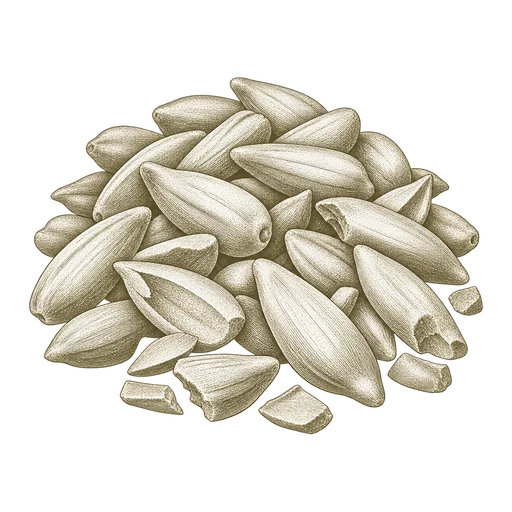
Sunflower kernel chips are pieces of sunflower seed kernel used as an ingredient in blended bird feed. Their value in a formulation depends not just on the ingredient name, but on the piece size and condition that the blend is designed to handle. Define what the chips need to contribute to your particular blend before comparing product offers.
A supplier’s bird-feed designation is useful information about the intended market for a product, but it does not establish universal suitability for every bird-feed formulation or use. Treat the designation as a starting point. The product’s current specification and intended-use labeling should describe what is actually offered and help you assess whether it matches your requirements.
Chip size affects blend consistency
“Medium” is a size description, not a complete measure of how a lot will behave in a blend. Ask how the supplier defines the size grade and what the current specification says about the distribution of piece sizes. A buyer who needs a consistent visual appearance or a particular particle profile needs a clearer definition than the grade name alone.
Compare the chip dimensions with the other ingredients and the finished product. Pieces much larger or smaller than the surrounding components can be distributed differently during mixing or handling. The practical question is whether the offered size profile fits your process and the blend you intend to make—not whether a grade name sounds appropriate in isolation.
Grade and fines tell different parts of the story
Grade identifies a product category according to the supplier’s definition; it does not, by itself, tell you the proportion of intact pieces, smaller fragments or fines. Fines are small particles produced or present alongside the larger chips. If the amount matters to your formulation or finished blend, look for a relevant specification measure rather than inferring it from the grade.
Fines can change the balance between visible pieces and smaller material in a blend, and may affect how the ingredient moves through your processing and handling steps. Decide what matters operationally: for example, whether your process can accommodate the offered particle distribution and whether the finished blend has a defined expectation for chip size. Avoid substituting a general grade label for those specific criteria.
Assess cleanliness against the current specification
Cleanliness is a separate consideration from size. Review how the specification describes foreign material and other cleanliness criteria relevant to your use. If the document does not define a characteristic you need to evaluate, do not assume that a broad description such as “clean” establishes a particular limit or inspection method.
Use the product’s intended-use labeling and specification together. They help clarify the supplier’s product description, the characteristics being represented and whether the offer is aligned with your formulation needs. If cleanliness is critical to your process or finished blend, identify the specific requirement before comparing offers so you are not relying on an undefined general term.
Make the decision with a defined product and use
A practical evaluation brings four questions together: what the supplier means by the size grade, how the specification describes the distribution of pieces and fines, what cleanliness criteria are stated, and whether the intended-use labeling matches your application. These are related but not interchangeable checks. A suitable size profile does not answer a cleanliness question, and a bird-feed designation does not replace a current product specification.
Before requesting a quote, have the formulation requirements and the relevant specification questions ready. Provide the desired product description, quantity and destination, and state which size, fines or cleanliness characteristics matter. Once those requirements are set, review the [Medium Sunflower Chips] page to source the ingredient. Exact product characteristics and commercial terms depend on the offer being considered.