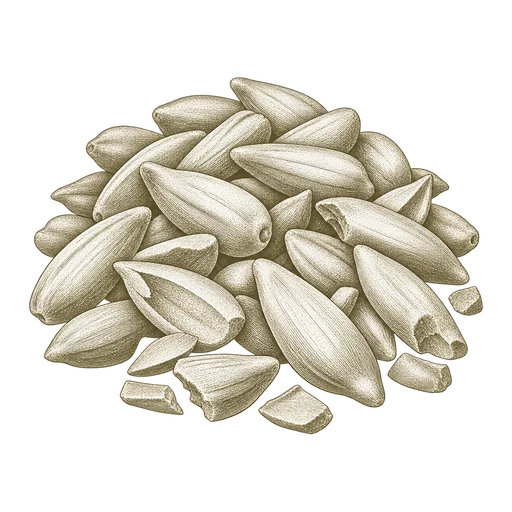
Why “coarse” needs a defined measure
“Coarse” is a useful product description, but it does not specify how large the sunflower chips are or how consistently they are sized. One seller may use the word for material that is mostly retained on a particular screen; another may describe a blend containing several size fractions. Without a measurable definition, two offers labeled coarse can behave differently in a feed blend or finished product.
For comparison, ask for either a screen-based definition or a particle-size distribution. A screen-based specification identifies the sieve openings used and describes what passes or remains. A distribution reports the share of a sample in multiple size bands. The first can be straightforward when one cut is the key requirement; the second gives a fuller picture of variation across the lot.
Read a distribution, not just a top-size claim
A single screen threshold can tell you whether material is larger or smaller than that opening, but it does not show how the rest of the sample is divided. A particle-size distribution helps distinguish a concentrated cut from a broad mix: look for the screen sizes used, the reported fraction associated with each screen, and whether the results account for the full sample.
Check how the result is expressed. Percentages may be reported as material retained on each screen, material passing through it, or cumulative retained or passing amounts. These describe the same sample in different ways, so the specification should label the basis clearly. If the supplier uses a sieve test, request the sieve-opening sizes and the stated test procedure, including how the sample is prepared and tested. Do not compare results until you know the reporting convention and method are compatible.
Interpret fines and hull remnants separately
Fines are the smaller particles in a chip product. Their share matters when your process or finished blend depends on a more uniform coarse fraction. A fines limit is meaningful only when the specification defines what counts as a fine—for example, by naming the screen opening below which material is counted—and explains how that share is measured. The word “low” alone is not a comparable limit.
Hull remnants are a different characteristic from particle size. They refer to hull material remaining among the chips, so a particle-size result cannot stand in for a hull-remnant limit. If hull content affects your formulation or product appearance, ask how it is identified and reported, whether as a measured proportion or a stated description. Do not assume a threshold used by one supplier is an industry-wide standard; compare the actual definitions and requirements relevant to your use.
Fields to include in a useful specification
A practical specification for coarse sunflower chips should name the product and define its size basis. Record the screen openings and the passing or retained fractions, or request the distribution across the stated size bands. Include the permitted fines level only with its cutoff screen and measurement basis. If hull remnants matter, list that requirement separately and ask for its evaluation method.
Also establish whether the result describes a typical product profile, a contractual limit, or a test result for the offered lot. These are not interchangeable: a general product description does not show that a particular shipment met a defined requirement. For lot-specific comparison, ask which sample was tested, how it was taken and prepared, and which method was used. Those details help you judge whether the reported result represents the material you are considering.
Compare like with like before setting a limit
Start with the size distribution your receiving, mixing or finished-product process can use, then state the screens and reporting basis that describe it. Avoid choosing a fines or hull-remnant threshold solely because it appears on another supplier’s sheet. Different definitions can make superficially similar numbers incomparable, and a requirement that is not tied to your process may exclude material without improving the result you need.
When requesting a quote for Coarse Chips, provide your preferred size definition, any fines or hull-remnant requirements, and the method or documentation needed to evaluate them. Ask the supplier to identify the measurement basis for the offered lot. This makes it easier to compare the actual material and its test information rather than relying on the word “coarse.”
BEFORE YOU REQUESTYour sourcing checklist.
- Specify screen openings or the particle-size bands needed; state whether results should be reported as passing, retained or cumulative fractions.
- Define fines by the screen cutoff and the measurement basis, rather than using an unqualified term such as “low fines.”
- State separately whether hull remnants matter and how that characteristic should be evaluated.
- Ask whether results describe a general product profile or the offered lot; identify the sample and test method when lot-specific results are required.
- Share the intended use, order quantity and unit, destination, and receiving constraints when requesting a quote.
Common questions.
What does “coarse” mean for sunflower chips?+
It has no useful measurable meaning unless tied to screen openings or a particle-size distribution. Request the screen sizes and the passing or retained fractions so you can compare products on a defined basis.
Are fines and hull remnants the same specification?+
No. Fines are smaller particles, usually defined by a screen cutoff. Hull remnants describe remaining hull material and need a separate definition and evaluation method if they matter to your use.
Can I compare particle-size results from different suppliers directly?+
Only after checking that the screen openings, sample preparation, test procedure and reporting basis are compatible. Results expressed as passing, retained or cumulative fractions can look different even when describing similar material.