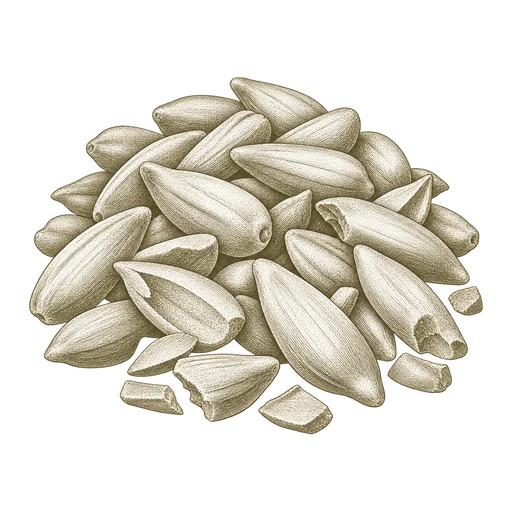
Whole seed and sunflower meal are different ingredients
Whole black-oil sunflower seed retains both its hull and its oil. Sunflower meal is produced after oil extraction, and its composition depends in part on how much hull remains and how the seed was processed. They are related products, but they should not be treated as interchangeable entries in a feed formula.
The distinction matters because the whole seed brings oil and hull material into the ration together. Meal has had much of the oil removed, so it presents a different balance of nutrients; the amount of hull retained also affects its composition. A nutritionist evaluating either ingredient needs to work from the actual product form and analysis, not a generic value for “sunflower.”
What each form changes in a ration
For whole seed, retained oil is a relevant source of dietary fat and energy, while the hull contributes fiber. Those features can influence how the ingredient fits with the rest of the ration. The seed’s nutrient contribution should therefore be considered alongside other fat and fiber sources, rather than added as though it were a protein meal.
Sunflower meal is commonly considered as a protein-bearing feed ingredient after oil extraction. Its protein and fiber profile can differ with processing and hull retention. Meal with more hull material does not have the same nutrient balance as a more dehulled product, so the name alone does not establish its value in a formulation.
Neither form has a universal inclusion rate or guaranteed result across animal species and diets. The appropriate use depends on the complete ration, the animal and production context, and the composition of the offered ingredient. A qualified nutritionist should assess those factors together.
Analysis a nutritionist may need
Start with an analysis that identifies the specific form—whole seed or meal—and gives the basis for its reported values. Moisture helps interpret nutrient concentrations and storage condition. Crude protein, crude fat and fiber measures help distinguish the ingredient’s contribution and reveal why two sunflower products may not substitute directly.
The nutritionist may also need an energy value appropriate to the species and formulation method, as well as additional nutrient results relevant to the rest of the ration. Energy is not a single context-free number: the method used to estimate or report it should be clear before it is compared with other ingredients. If the formulation depends on amino acids or other specific nutrients, request the relevant analysis rather than inferring it from crude protein.
Compare results on the same basis, such as as-fed or dry matter, or have the nutritionist convert them consistently. For meal, ask whether the analysis corresponds to the processing and hull content of the product being quoted. A specification for one meal type should not be assumed to describe another.
Match the ingredient to the formulation question
If the formulation calls for a whole seed ingredient, black-oil sunflower seed is the relevant product to evaluate: it retains its oil and hull. If the formula calls for an oil-extracted meal, specify sunflower meal and compare its analysis and hull retention. Naming the intended form at the start prevents a quote or ingredient comparison from drifting between distinct products.
When comparing alternatives, ask the nutritionist to assess how the ingredient changes the full ration—not just one nutrient. The added fat from whole seed, or the protein and fiber balance of meal, can affect the contribution expected from other ingredients. Do not transfer a formulation value from whole seed to meal, or vice versa, without checking the composition and calculation basis.
Define the form before sourcing
For a bulk inquiry, specify whole black-oil sunflower seed or sunflower meal, the quantity and unit, destination, and the analysis requirements that matter to the formulation. Include packaging or receiving constraints so the proposed product and shipment can be evaluated against the facility’s handling setup. Exact analysis, packaging, availability and commercial terms depend on the specific offer.
Once the formula calls for whole black-oil sunflower seed, use the Black Oils ingredient page to continue sourcing that form. If the nutritionist specifies meal instead, make that distinction explicit before comparing offers.
Common questions.
Can whole black-oil sunflower seed replace sunflower meal in a feed formula?+
Not as a direct one-for-one substitution. Whole seed retains its hull and oil, while meal has undergone oil extraction and varies with processing and hull retention. Have a nutritionist reformulate using the actual analysis for the intended product.
Which analysis should I request for sunflower seed or meal?+
Identify the form and request an analysis with a clear reporting basis. Moisture, crude protein, crude fat and fiber measures help distinguish composition; ask for energy or other nutrient results when they are needed for the species and formulation method.
What information helps price a bulk order of black-oil sunflower seed?+
A useful quote requires the exact form, quantity and unit, destination, timing, packaging or receiving method, and any relevant quality analysis. Delivered pricing depends on the specific offer and shipment details.