Choose the form for the job
The right sunflower ingredient for a bakery recipe depends first on where it needs to perform. Whole kernels create distinct, visible pieces; chopped kernels distribute smaller pieces through a dough or topping; roasted grits bring a more fragmented texture and toasted character. Defatted sunflower flour is different again: it is a ground, oil-reduced ingredient, not simply a finer version of whole kernels.
These forms are not interchangeable by weight or function. Particle size affects how evenly kernels disperse and how noticeable they are in the finished product. Processing also changes the ingredient’s composition and sensory contribution. Decide whether the recipe needs visible pieces, a crunchy or toasted accent, or a ground ingredient before specifying a form.
Whole and chopped kernels in dough
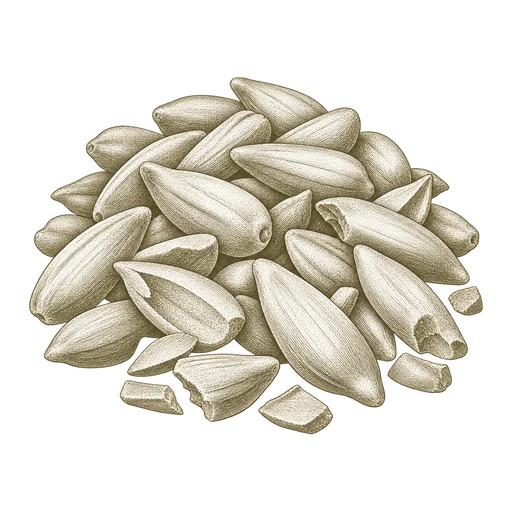
Whole kernels remain individually noticeable in breads, biscuits and other baked goods. They can provide a clear seed texture in the crumb, but their size makes distribution and bite different from smaller pieces. In a dough with limited space for inclusions, whole kernels may also create a more pronounced local concentration of seed than a finer form.
Chopped kernels break that structure into smaller pieces. They can be easier to distribute throughout a dough or across a topping, but the result depends on the chop size and the recipe. Smaller pieces change the balance between visible kernel, texture and background flavor; they do not guarantee a particular crumb or finished-product texture. Specify the desired particle character rather than relying on the word “chopped” alone.
Roasted grits for toppings and fillings
Sunflower grits are broken or coarsely ground kernel pieces. Roasting gives them a toasted flavor and can make them useful where that note is part of the recipe, including toppings and fillings. Their smaller, irregular particles offer a different appearance and mouthfeel from whole kernels, and can spread across a surface or through a mixture more readily.
Roasting and particle size both matter in a bakery trial. A grits product’s flavor and color can influence the result, while the piece size affects how it sits in a topping or filling. Check that the trial ingredient matches the intended product form and roasting treatment. A result with roasted grits should not be assumed to predict performance with raw whole kernels or chopped kernels.
Defatted sunflower flour is a formulation ingredient
Defatted sunflower flour is produced from sunflower material after much of its oil has been removed, then milled. Its reduced oil content distinguishes it from whole kernels, which retain their natural oil. Because it is a flour rather than discrete seed pieces, it disperses through a formula differently and contributes no whole-kernel appearance.
Replacing kernels with defatted flour therefore changes more than particle size. The ingredient’s composition and role in the recipe change, so the substitution can affect dough handling and the baked product. Treat it as a separate formulation decision, not a direct swap. Verify any claims about absorption, structure, flavor or finished-product performance with the exact flour and recipe.
Run trials that match the production ingredient
A bakery trial is useful only when it represents the ingredient the plant intends to buy and use. Record the form, particle size description, roasting status where relevant, and the recipe and process used. Assess the product in its actual role: dough inclusion, surface topping or filling component. Note distribution, appearance, flavor and texture rather than judging the ingredient in isolation.
Do not convert a successful bread, biscuit or cake trial into a universal inclusion rate. Recipe composition, mixing, shaping and baking conditions all affect the result, and a different sunflower form can behave differently. For commercial sourcing, define the required form and intended application first, then use the Bakery Kernels page to identify the ingredient category for a sourcing inquiry.
Common questions.
Can chopped sunflower kernels replace whole kernels in a bakery recipe?+
Not without checking the result. Chopping changes particle size, distribution and how noticeable the kernels are in the finished product. Trial the intended chop in the actual recipe before treating it as an equivalent.
Are roasted sunflower grits the same as defatted sunflower flour?+
No. Roasted grits are fragmented kernel pieces with a toasted character; defatted sunflower flour is milled material from which much of the oil has been removed. Their composition, texture and roles in a recipe differ.
Does a successful bakery trial establish a general inclusion rate?+
No. A trial applies to the ingredient form, recipe and process tested. Different products and kernel forms can produce different results, so verify the intended formulation with the actual ingredient.