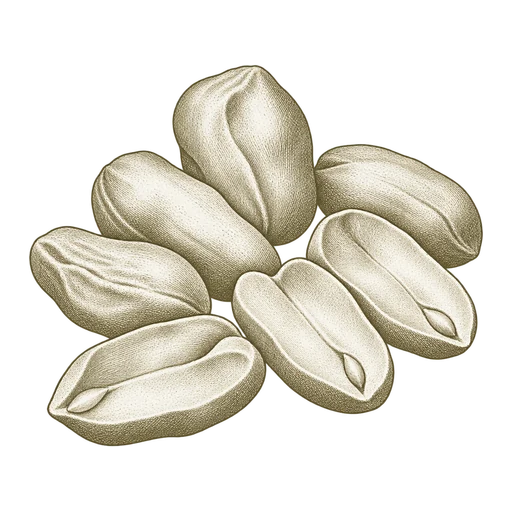
The deciding question: does your process need the shell?
Fancy Inshells are whole nuts supplied with the shell still on. A kernel specification describes the nut after shelling. Those are different physical products, so the right choice depends on what your process needs to receive and what the finished product is meant to contain.
Choose an inshell form only when the process or finished product calls for whole nuts presented with their shells. If production requires exposed kernels—for example, to mix, coat, chop or incorporate them as an ingredient—the shell is an added separation step, not part of the kernel specification. The product name alone does not establish whether a lot fits a particular food process.
What changes when you buy whole nuts instead of kernels?
An inshell shipment contains both the outer shell and the kernel. A kernel shipment has already had the shell removed. As a result, the two forms differ in what enters the plant, how the material can be fed into equipment, and whether shelling needs to occur before later processing.
That distinction affects process planning. A line designed to handle kernels may require a separate shelling operation if it receives inshell nuts. Conversely, a product designed around whole nuts in their shells cannot be made from kernels alone. Decide at the product-design and process-flow stage, rather than treating inshell and kernel offers as interchangeable versions of the same specification.
Match the form to the actual operation
For an intended shell-on food product, the receiving, handling and processing steps must accommodate whole nuts with shells. Confirm that the process is designed for the shell to remain through the relevant steps, or that it includes a planned way to remove it. Do not assume the word “Fancy” establishes a fit for a particular process or finished product.
For a process that uses kernels, specify that requirement directly. If shelling will take place at your facility, account for the added operation and determine what material the next step will receive. If shells are not part of the finished product or process, request a kernel specification instead of relying on an inshell description.
Identify the nut and verify the documents
Before comparing offers, establish the nut’s identity, the intended form and the requirements for your process. “Fancy Inshells” is a product name, but the buyer still needs the exact nut identity and the offered lot’s specification. A kernel document and an inshell document may describe different material and should not be treated as equivalent.
Tell the supplier or broker what the food process does with the shell and what the finished product requires. Review the available product identification, lot specification and other documentation your operation needs to assess the material. The documents should correspond to the exact offered form and lot; do not infer food-use suitability, approval or a particular grade from the product name alone.
A practical decision before sourcing
Write down the required incoming form, where shelling happens (if at all), and which documented characteristics your process needs to evaluate. Then compare only offers that describe the same nut and form. This prevents a price comparison between whole inshell nuts and kernels from obscuring the extra processing or material difference.
For a precisely identified offer, visit the Fancy Inshells ingredient page and use the inquiry to state the nut, intended operation, required form and documentation needed. Exact lot details and commercial terms are supplier-dependent.
BEFORE YOU REQUESTYour sourcing checklist.
- Identify the exact nut and state whether the required incoming product is inshell or shelled kernel.
- Describe the intended process and whether the shell remains, is removed before processing or is removed at your facility.
- Specify the lot information and documentation your operation needs to assess the material; ensure it applies to the offered form.
- For a quote, provide quantity and unit, destination, timing, packaging or receiving constraints, and any process-specific quality requirements.
Common questions.
When does Fancy Inshells make sense for food processing?+
When the process or finished product calls for whole nuts with their shells on, and the operation can handle that form. If the next step requires kernels, specify shelled kernels or account for shelling as a separate process.
Are Fancy Inshells interchangeable with a kernel specification?+
No. Inshell nuts include the shell as well as the kernel; a kernel specification describes material after shelling. They differ in incoming form and may require different handling and processing steps.
What should I verify before sourcing Fancy Inshells for a food process?+
Verify the exact nut identity, whether the offer is inshell or kernel, the intended processing use, and that the available product and lot documents describe the form being offered. Do not infer food-use suitability or approval from the product name.