Kernels without the red skin
Removing the seed coat supplies a different starting material for processes such as peanut butter or salted peanut production. Residual skin expectations still need to be specified for the intended product.
Ingredient intelligence · quote-ready sourcing
Also searched as Blanched peanut kernels, Skinless peanuts
Blanched peanuts are shelled kernels with the red seed coat removed, used in food processing such as peanut butter and salted peanuts. Compare kernel form, heat-treatment status, skin removal, and lot-specific quality information to match the product to your process.
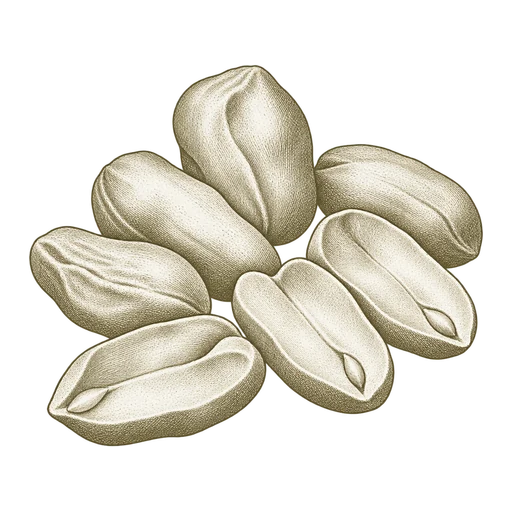
Blanched peanuts are shelled peanut kernels with their thin red seed coats removed. Conventional dry-heat blanching warms and slightly dries the kernels to loosen the skins before removal. Water blanching is also a skin-removal process; the product name alone does not identify the method.
Blanching does not establish whether kernels are raw or roasted, whole or split, or within a particular size, color, moisture, or residual-skin specification. Those characteristics should be defined separately because they can affect how the kernels enter a food process and the appearance of the finished product.
Removing the seed coat supplies a different starting material for processes such as peanut butter or salted peanut production. Residual skin expectations still need to be specified for the intended product.
Blanching is skin removal, not a guarantee of roasting. Separating those details helps prevent a heat-treatment assumption from being built into a product name.
Whole and split kernels are not interchangeable for every line or finished food. Kernel integrity, size, and breakage are useful comparison points when choosing the form.
| Characteristic | Why it matters |
|---|---|
| Blanching method | Identifies how the seed coat was loosened and removed. |
| Heat-treatment status | Blanching alone does not establish whether kernels are raw or roasted. |
| Kernel form and integrity | Whole or split form, size, and breakage affect processing and finished appearance. |
| Residual skin and color | These attributes can matter when kernels remain visible in the finished food. |
| Moisture and test basis | A lot value, measurement basis, and test method support meaningful comparison and storage planning. |
| Aflatoxin documentation | Lot identification and applicable test results provide information not conveyed by the blanched appearance. |
No universal commercial limits are established here. Compare the offered lot’s specification and supporting documentation with the requirements of the intended food process.
Blanched kernels are used as an input for products such as peanut butter and salted peanuts. Removing the skin gives processors a kernel without its red seed coat before subsequent operations, including roasting or grinding. The right kernel form depends on what happens next: whole kernels and smaller pieces do not necessarily behave alike in a process or finished product.
These uses do not make every lot suitable for every food application. Color, flavor, kernel uniformity, residual skin, and breakage can affect acceptance and processing. Set requirements around the actual product and process—for example, whether intact kernels matter or whether the next step grinds them.
A useful specification describes the product beyond its name. Compare the blanching method, heat-treatment status, kernel form, and the quality attributes important to your application. For moisture, request the lot value, measurement basis, and test method; a general peanut-storage reference is not a contractual limit for a particular blanched-kernel lot.
Ask for lot identification and applicable aflatoxin test documentation. A skin-removed appearance does not establish a test result. If your facility has allergen-control or other food-safety documentation requirements, state them clearly so the offered lot can be evaluated against them.
Peanut storage quality depends in part on moisture management and ventilation. Keep receiving and storage plans consistent with the specific product’s handling guidance, and avoid assuming that a recommendation for shelled peanuts applies unchanged to blanched kernels. Temperature and humidity changes during storage and transit are also relevant to handling plans.
For a bulk order, packaging, net quantity, unloading method, and destination affect whether the shipment can be received and stored as intended. Share facility constraints, such as available unloading equipment and protected storage, before freight is arranged. Commercial terms, including packaging and delivered price, depend on the offered lot and shipment.
Blanched kernels can serve as an input before roasting and grinding. Heat-treatment status, kernel quality, and the processor’s requirements should be considered separately from skin removal.
Blanched kernels are used in salted peanut processing. Kernel integrity, appearance, and the subsequent process help determine whether a particular form meets the finished product’s needs.
Food processors can evaluate blanched peanuts as an ingredient when a skin-removed kernel fits the process. Define the required kernel form, quality attributes, and lot documentation for the specific product.
Specify whole or split kernels, blanching method, heat-treatment status, quantity and unit, destination, and requested timing. These details distinguish the product needed for processing and help frame a delivered quote.
State the packaging and net quantity required, along with unloading equipment and any receiving constraints. Packaging and handling arrangements need to fit the facility’s receiving method; do not assume a particular package or shipment format.
Plan protected storage with attention to moisture, ventilation, and changes in temperature and humidity. Obtain handling guidance for the offered blanched kernels, rather than applying a general shelled-peanut reference as a lot-specific storage limit.
Fancy Inshells needs a precise nut identity and grade. U.S. Fancy Hand Picked applies to cleaned Virginia-type inshell peanuts; buyers should distinguish that standard from lot analysis and intended-use documentation.
Explore ingredientNo. Blanching removes the seed coat; it does not by itself establish that kernels are roasted. Confirm the offered heat-treatment status separately.
Compare whole or split form, blanching and heat-treatment method, kernel size and integrity, residual skin, color, moisture basis, and lot-specific quality documentation. The important attributes depend on the food product and processing line.
Plan storage around the lot’s moisture and handling guidance, with attention to ventilation and changes in temperature and humidity. Delivered pricing depends on the offered product, quantity, packaging, destination, and shipment timing.
Send your volume, destination, and key specifications. A broker can follow up with availability and commercial terms.