Start with the finished blend
Choosing raw peanut pickouts for bird food blends is chiefly a particle-size decision. Whole kernels, splits and smaller pieces can all contribute peanuts to a blend, but they differ in appearance, how they move through equipment and how evenly they distribute alongside other ingredients. The right form depends on what the finished product should look like and how it will be mixed, packed and presented.
Define the role of the peanuts before settling on a form. Are they meant to be a prominent, recognizable component, or should pieces be distributed throughout the mix? Will the product be sold loose or in a package where the blend’s appearance matters? These questions help translate a general request for peanuts into a clear particle-size requirement.
Whole kernels, splits and smaller pieces
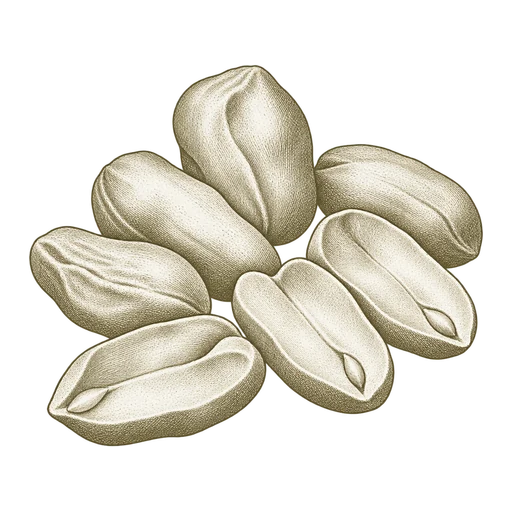
Whole kernels retain the most recognizable peanut shape. They can create a visibly substantial component in a finished blend, but their larger size makes them physically distinct from small seeds or other fine ingredients. If the size contrast is not intended, whole kernels may stand out more than the recipe calls for.
Splits are kernels divided into larger sections. They keep much of the recognizable character of peanuts while offering smaller pieces than intact kernels. Splits can be a practical middle ground when a blend needs visible peanut pieces without relying entirely on whole kernels. The precise appearance still depends on the size distribution in the supplied lot.
Smaller pieces can be easier to distribute among other ingredients when their dimensions are closer to those of the surrounding components. However, a mix of widely different particle sizes can separate as it is handled or transported: larger pieces and fine material may not remain evenly distributed. Fines can also affect the appearance and handling of a blend. For that reason, ask how the offered product is described and whether piece-size information or a sample is available.
Think about the whole mixing and packing line
Particle size affects more than the recipe sheet. Consider the path from receiving to the finished package: how the ingredient enters the mixer, whether it passes through screens or metering equipment, how the blend is transferred, and whether it is packed in a way that could encourage separation. Equipment openings and feed mechanisms designed around small seeds may not handle larger kernels in the same way. Conversely, selecting smaller pieces solely for ease of mixing may not deliver the visible appearance the product requires.
A trial blend can reveal practical issues before a larger purchase. Observe whether the peanuts feed consistently, whether the mixture looks uniform after blending, and whether pieces remain distributed after the same handling steps used in production. Evaluate both the blend at the mixer and the packaged product; a uniform batch can change as ingredients settle or shift during subsequent handling.
Do not assume that a smaller piece automatically blends better. The result depends on the sizes and proportions of every ingredient, the mixing process and the amount of handling. If the recipe includes components with very different particle sizes, the peanut form should be evaluated as part of the full blend rather than in isolation.
Specify the form in buyer language
A useful purchasing description names the intended form and the role it must serve. For example, state whether the blend calls for whole kernels, splits or smaller pieces, then describe the appearance and mixing behavior you need. If there is a size specification in your formulation, share it; if not, a representative sample or agreed visual standard can help make expectations clearer.
Also distinguish the form from the quality and use requirements. A description such as “peanut pieces” does not by itself establish a particular size distribution, analysis, handling history or suitability for a specific bird-food market. Identify any required quality documentation or market criteria separately, and have those requirements reviewed for the intended product and jurisdiction. Species-specific suitability and feeding rates should not be inferred from particle size.
For a bulk quote, provide the desired form, quantity and unit, destination, timing, and your receiving and packaging needs. Packaging options and commercial terms depend on the specific offer, so share any constraints that could affect receiving or production.
Frequently asked questions
**Are whole kernels or splits better for bird food?** Neither is universally better. Whole kernels create a more prominent visual component; splits retain recognizable peanut pieces at a smaller size. Choose according to the finished blend’s appearance and how your equipment handles the ingredient.
**Will smaller peanut pieces blend more evenly?** They can be closer in size to small blend components, but particle-size differences across the full recipe and subsequent handling also affect distribution. Test the complete blend and inspect it after packing or other routine transfers.
**What should a buyer request when sourcing raw peanut pickouts?** State the required form, the intended appearance or size criteria, order quantity and unit, destination, timing and receiving constraints. Share any applicable quality or market requirements as separate specifications.
Once the blend’s form and end-use criteria are clear, visit the Raw Pickouts ingredient page to pursue sourcing options.
Common questions.
Are whole kernels or splits better for bird food?+
Neither is universally better. Whole kernels create a more prominent visual component; splits retain recognizable peanut pieces at a smaller size. Choose according to the finished blend’s appearance and how your equipment handles the ingredient.
Will smaller peanut pieces blend more evenly?+
They can be closer in size to small blend components, but particle-size differences across the full recipe and subsequent handling also affect distribution. Test the complete blend and inspect it after packing or other routine transfers.
What should a buyer request when sourcing raw peanut pickouts?+
State the required form, the intended appearance or size criteria, order quantity and unit, destination, timing and receiving constraints. Share any applicable quality or market requirements as separate specifications.