A brewing residue with feed value
Brewer’s spent grain contains fiber and protein, which help explain its use in livestock feed. The actual contribution to a ration depends on the lot’s analysis and the other ingredients in the complete feed.
Ingredient intelligence · quote-ready sourcing
Also searched as Brewers’ spent grain, Brewers spent grain, BSG
Brewer’s grain, or brewers’ spent grain, is a brewing co-product used particularly in cattle feed. Wet and dried forms differ in moisture, transport burden and storage needs; compare the offered form and lot analysis with your ration and receiving setup.
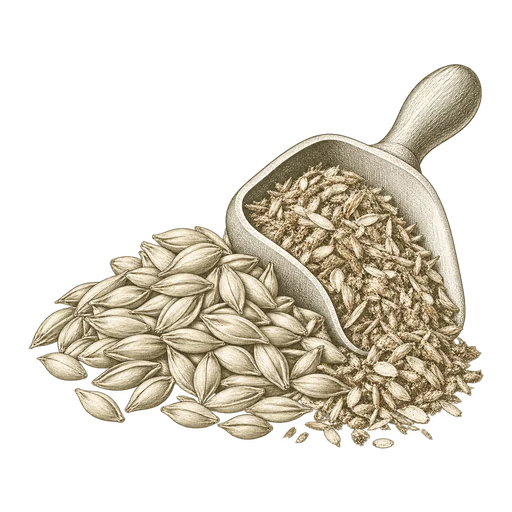
Brewer’s grain usually means the solid residue left after malted grain is mashed and liquid wort is separated. It consists largely of insoluble grain coverings, especially husks, and is distinct from spent yeast, spent hops and distillers’ grains.
The material is handled wet or after drying. Barley is the principal traditional brewing grain, but other grains or adjuncts can be used, so the name alone does not identify a consistent grain mix or nutrient profile.
Brewer’s spent grain contains fiber and protein, which help explain its use in livestock feed. The actual contribution to a ration depends on the lot’s analysis and the other ingredients in the complete feed.
Wet material carries more water, increasing transported weight and making storage more time-sensitive. Drying reduces the water moved and improves storability, but adds a processing step that should be identified when comparing product offers.
Brewer’s grain can come from different grain bills and brewing processes. Confirming the inputs and reviewing lot-specific results gives a feed formulator a sounder basis for comparing materials than the common product name alone.
| Characteristic | Why it matters |
|---|---|
| Wet or dried form | Affects transported water, storage demands and receiving arrangements. |
| Moisture or dry matter | Provides context for handling and for comparing nutrient results on the same basis. |
| Crude protein and fiber fractions | Help a nutritionist evaluate the ingredient’s role in a particular feed formulation. |
| Fat and ash | Add detail for comparing the composition of offered lots. |
| Grain inputs and processing history | Clarify what brewing residues and further processing are represented by the product description. |
| Minerals or mycotoxin results, where relevant | Address additional quality considerations set by the intended ration or buyer’s program. |
These are comparison measures, not guaranteed values or universal acceptance limits. Request the offered lot’s analysis and note its measurement basis.
Brewer’s grain contains fiber and protein, but neither is a fixed value implied by the product name. Grain inputs, the brewing process, drying and storage can all affect the material. Published composition ranges are not a substitute for an analysis of the lot being offered, particularly when the measurement basis is unclear.
For feed formulation, request moisture or dry matter, crude protein, relevant fiber fractions, fat and ash. Mineral results or mycotoxin testing may also matter to a particular ration or quality program. Compare analyses on the same stated basis: moisture changes the apparent concentration of nutrients, so figures reported on different bases are not directly comparable.
Brewer’s spent grain is used as an animal-feed ingredient, particularly in cattle diets. Its fiber and protein content help explain that role, but the appropriate use depends on the animal class, the complete ration and the lot’s analysis. A nutritionist can assess whether a particular lot fits the intended formulation; the ingredient name alone does not establish an inclusion rate or suitability for every species.
Feed mills and livestock operations should distinguish the grain ingredient from other brewing residues and from products made by further processing it. Specify wet or dried material and the intended feed use when comparing offers, so the analysis and handling details can be assessed in context.
Research on brewer’s spent grain includes human-food applications, such as adding fiber to foods. That does not make an ordinary feed ingredient food grade. Buyers considering human-food use need to establish the ingredient’s identity, hygienic processing and intended-use documentation, along with the food-safety controls applicable to their operation.
For feed, likewise, do not infer processing history, safety documentation or a particular grain mix from the name alone. A current lot analysis and clear description of how the material was handled help buyers determine whether it fits their own quality program.
Brewer’s spent grain is used particularly in cattle diets. Its fiber and protein can contribute to a ration, but the lot analysis, animal class and complete formulation determine whether it fits a specific feeding program.
Formulators can assess brewer’s grain alongside other ration ingredients using the offered moisture or dry matter, protein and fiber results. Do not infer species suitability or an inclusion rate from the ingredient name alone.
Feed mills should distinguish wet from dried material and identify any further processing. The physical form and moisture affect how the ingredient is received and handled, while the analysis informs formulation decisions.
Specify wet or dried spent grain, any required processing, quantity and units, destination, intended feed use and requested timing. Form and moisture matter because wet material carries more transport weight and requires closer attention to storage.
Describe how the facility can receive and unload the material, including its storage arrangement and any packaging or bulk constraints. The receiving method should suit the actual offered form; confirm those details before arranging delivery.
Wet brewer’s grain presents a storage and perishability challenge because of its high moisture. Identify the planned storage conditions and obtain handling and shelf-life guidance for the offered material rather than assuming one protocol applies to every lot.
Alfalfa is a forage legume sourced as hay, silage, meal or pellets for livestock feed. Match the form to receiving and ration needs, then compare a lot-specific analysis on a consistent basis.
Explore ingredientAlfalfa meal is ground forage used in animal feed, with sun-cured and dehydrated processing routes and meal or pellet forms. Compare the offered process, physical form and analysis against the needs of the species and feed formulation.
Explore ingredientAlfalfa pellets are ground, compressed forage used in livestock feeding and compound feeds. Compare the drying process, alfalfa material, forage analysis and pellet characteristics to choose a form that fits your ration and receiving setup.
Explore ingredientBeet pulp pellets are a dried, compacted sugar beet co-product used as a fibrous, energy-bearing ingredient in livestock feed. Compare molasses status, lot analysis and pellet handling needs to match the product to your ration and receiving setup.
Explore ingredientBrewer’s grain usually refers to brewers’ spent grain, the solid residue left after mashing malted grain and separating the liquid wort. It is different from spent yeast, spent hops and distillers’ grains.
Wet brewer’s grain is handled as a moist brewing residue, so water adds transport weight and makes storage more time-sensitive. Drying reduces the water transported and improves storability, but it is an additional processing step. Confirm the actual form and handling guidance for the offered material.
The offered form and processing, quantity, destination, timing and freight arrangements affect a delivered quote. Include your receiving setup and required analysis so the broker can assess the relevant product and delivery terms.
Send your volume, destination, and key specifications. A broker can follow up with availability and commercial terms.