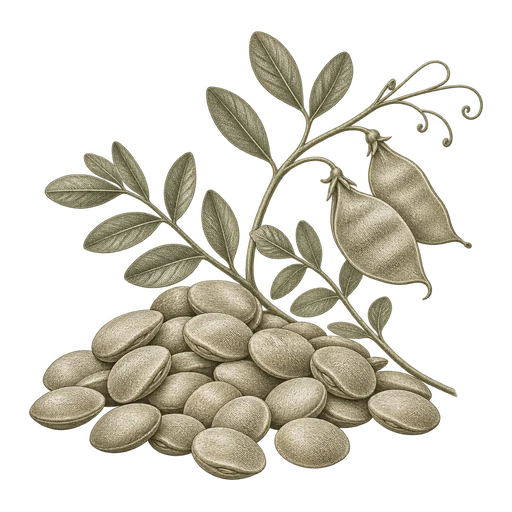
Distinct seed and forage forms
Dry seed is handled differently from hay or silage and serves a different purpose. Naming the required form helps prevent comparisons between products that are not substitutes.
Ingredient intelligence · quote-ready sourcing
Also searched as Austrian field pea
Austrian winter peas are a field pea type supplied for uses including cover cropping, forage and livestock feed. Specify whether you need planting seed, dry grain, hay or silage, since each form serves a different purpose and has different quality considerations.

Austrian winter pea is a type of field pea, commonly identified as Pisum sativum subsp. arvense. It is used as a winter forage or cover crop; harvested seed may also be used in livestock feed.
Planting seed, dry grain, hay and silage are distinct forms rather than interchangeable grades. Seed color varies by variety and source, and does not by itself establish product identity or quality.
Dry seed is handled differently from hay or silage and serves a different purpose. Naming the required form helps prevent comparisons between products that are not substitutes.
Dry pea grain can be fed whole, rolled or ground. Rolling or grinding changes particle size and handling, so the form should fit the feed-mixing process.
Moisture, cleanliness, damage and, where relevant, nutritional analysis help describe the offered lot. Seed color alone is not a dependable substitute for identity or quality information.
| Characteristic | Why it matters |
|---|---|
| Product identity and intended use | Distinguishes planting seed, dry grain and forage products. |
| Moisture | Informs storage planning for dry seed or grain. |
| Foreign material and damage | Helps describe cleanliness and the condition of a seed or grain lot. |
| Nutritional analysis | Supports feed comparisons when required for the intended ration. |
| Test weight or seed size | Can help compare grain lots when these measures matter to the buyer. |
These are comparison measures, not guaranteed specifications. Values and testing needs depend on the lot and intended use.
In a cover-crop rotation, Austrian winter pea is a legume that can fix nitrogen. The result depends on establishment, growth and termination conditions; seed identity by itself does not indicate how much biomass or nitrogen a field will produce.
For livestock, pea seed can serve as a feed ingredient, but a common name cannot establish the nutritional value or suitability of a particular lot for a species or ration. Feed buyers should compare a representative lot analysis with their nutrition requirements. Forage buyers should distinguish silage or hay needs from grazing plans: these plants are vulnerable to trampling and are poorly adapted to grazing.
Seed color varies among varieties and sources, so appearance alone is not a reliable identity or quality test. Establish the product type and intended use, then assess relevant lot characteristics such as moisture, foreign material, seed damage and cleanliness.
For dry seed used in feed, test weight, seed size and nutritional analysis can help buyers compare lots when those measures matter to the application. These values are not universal Austrian winter pea specifications. Ask for results on the offered lot rather than inferring feed value from the crop name.
Moisture and temperature affect safe storage of dry peas, and storage guidance depends on the actual lot and intended holding period. Plan storage using the lot’s moisture and temperature conditions rather than assuming a single threshold applies to every Austrian winter pea shipment.
Before arranging a bulk order, identify whether the requirement is for planting seed, dry feed grain, hay or silage. Quantity, destination, timing, packaging and receiving equipment help define a shipment that fits the operation. Delivered price depends on the offered product and the shipment’s volume, destination and timing.
Austrian winter pea is used as a legume cover crop in rotations. Establishment and termination conditions affect growth and the resulting field benefits, so planting seed should be distinguished from grain intended for feed.
Pea seed can be used as a livestock feed ingredient. Whole, rolled and ground forms differ in particle size and handling; the actual lot analysis and species-specific ration requirements determine whether it fits a feed program.
Winter pea forage is used for silage and can be made into hay, though curing hay can be difficult. The viney plants are vulnerable to trampling and are poorly adapted to grazing.
State whether the requirement is planting seed, dry grain, hay or silage, along with quantity and unit, destination and timing. These details distinguish the product and define the shipment being priced.
Describe how the facility receives material and any unloading constraints. Identify the packaging required for the operation, since the receiving setup must suit the form and packaging offered.
For dry seed or grain, use the lot’s moisture and storage conditions to plan handling and storage duration. Keep the material protected from moisture and contamination, and do not apply a generic storage threshold without considering the actual lot.
Dry black beans are used in packaged foods, prepared dishes and canning. Compare whole versus broken or split composition, and assess canning performance separately when the beans will be processed.
Explore ingredientChickpeas are dry edible pulses sold as Kabuli or Desi seed, whole, split, dehulled or milled into flour. Choose class and form to match the food process or formulation, and compare lot moisture, size, defects and receiving needs.
Explore ingredientFaba beans are grain-legume seeds used in food and feed, supplied in forms ranging from whole or split seed to milled and more highly processed ingredients. Choose by intended use and form, then compare the relevant lot analysis and handling needs.
Explore ingredientGreen lentils are dry pulse seeds sold in forms such as whole, split, dehulled and flour. Compare the processing form, grade documentation, color, moisture and cleanliness against the needs of your food process or reviewed feed formulation.
Explore ingredientNot necessarily. Both may be Austrian winter pea, but planting seed and harvested feed grain have different intended uses and quality requirements. Identify the form and use when requesting an offer; appearance alone does not establish a lot’s identity or grade.
Start with product identity, moisture, foreign material and damage. Where relevant to the ration, compare the lot’s nutritional analysis, test weight or seed size. These measures vary and should be based on the actual lot, not assumed from the commodity name.
The product form, quantity, destination and timing all affect a delivered quote, along with the packaging and receiving arrangement. Include those details in the request so the broker can assess the relevant offer and freight.
Send your volume, destination, and key specifications. A broker can follow up with availability and commercial terms.